Market Consensus Signals 23% Probability of U.S. Acquisition of Greenland by End of 2026
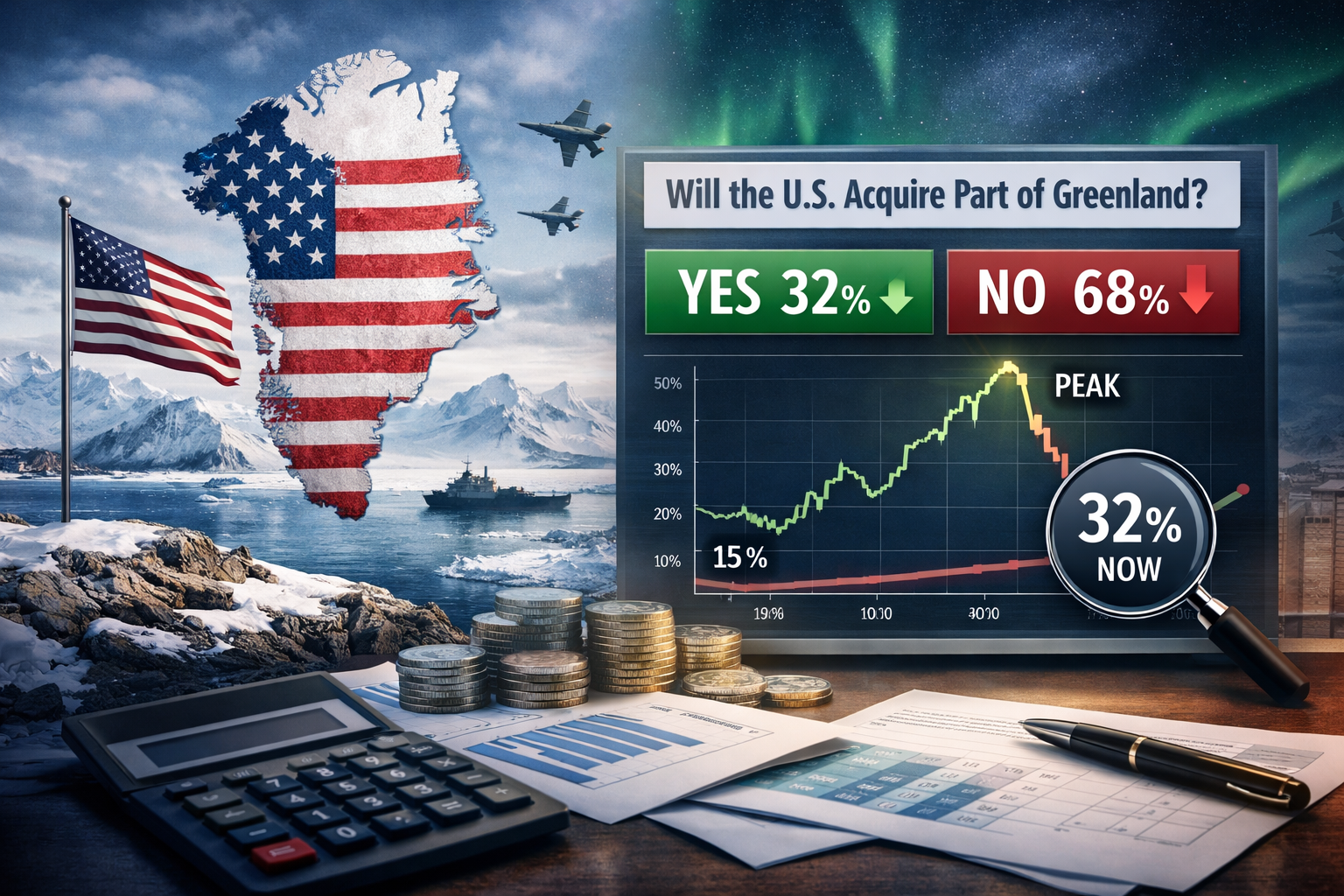
The prospect of a redrawn Arctic map remains a persistent, if heavily discounted, fixture of the geopolitical risk landscape. As of late January 2026, Polymarket participants have priced in a 23% market-implied probability that the United States will successfully acquire the territory of Greenland by the close of the year. This quantified consensus follows a week of intense rhetorical maneuvering at the World Economic Forum in Davos, where President Donald Trump shifted his strategy from explicit tariff threats toward a "security framework" negotiated with NATO leadership.
The Crowd’s Thesis: From Economic Coercion to Strategic Integration
The current 23% probability reflects a market that is aggressively weighing the "Tariff Bazooka" against the granite wall of Danish and Greenlandic sovereignty. The timeline of this consensus began with a sharp spike in early January, following the administration's announcement of a tiered tariff system—starting at 10% on February 1 and rising to 25% by June—specifically targeting Denmark and seven other European nations. Traders on platforms like Polymarket and Kalshi initially interpreted this as a high-stakes leverage play, driving odds from the single digits into the low 20s.
The Wisdom of Crowds is currently aggregating two distinct streams of information. On one hand, the market sees "skin in the game" through the skyrocketing valuations of Arctic-adjacent equities, such as Critical Metals Corp and Greenland Resources Inc., which have become proxies for U.S. industrial interest in the island's rare-earth minerals. On the other hand, the crowd is discounting the likelihood of a total transfer of sovereignty, recognizing that international law and the semi-autonomous status of Greenland create a "legal Everest" that even significant economic pressure may not scale.
The Signaling Effect of the 23-Cent Contract
In the sober language of prediction markets, the current 23-cent contract represents a skepticism that refuses to be ignored. While political commentators often focus on the spectacle of the "Golden Dome" missile defense system or the populist rhetoric of "North American territory," traders are focused on the structural impossibility of a fast-track sale. A 23% probability signals to the broader financial world that while a traditional "purchase" is unlikely, the market anticipates a significant "Value Gap" being bridged by a non-sovereign deal—potentially involving expanded basing rights or resource extraction licenses.
Explicit data from Kalshi further refines this outlook, with traders placing the odds of an acquisition at 42% when the timeframe is extended to the end of President Trump's term in 2029. This suggests the market views the current 23% number not as a failure of the policy, but as a recognition of the diplomatic "traffic" required to move from a security framework to an actual deed of sale.
Dual-Outcome Analysis: Sovereignty vs. Security Frameworks
The market is currently navigating two starkly different future paths. If the crowd’s minority outcome prevails and the U.S. secures a formal transfer of sovereignty, it would signal a systemic shift toward a new era of transactional geopolitics where economic dominance can forcibly override established territorial integrity. Conversely, if the 77% majority outcome holds and no acquisition occurs, it will highlight the limitations of collective intelligence in pricing "tail risk" generated by a single, unpredictable executive actor. This path would suggest that the market successfully distinguished between the "noise" of high-level negotiations—such as the framework discussed with NATO's Mark Rutte—and the actual "signal" of binding legal treaties that remain absent.
Market Outlook: The Convergence of Rhetoric and Reality
The current 23% predictability number suggests that the market has largely priced in the administration's pivot from military force to diplomatic and economic pressure. While the recent de-escalation at Davos—where the President ruled out kinetic intervention—cooled some of the more volatile speculative positions, the crowd is not yet convinced that the "Greenland Gambit" is over. The market is lagging behind a new, emerging catalyst: the specific details of the NATO security "framework," which may offer a face-saving middle ground that provides the U.S. with "total access" without the formal transfer of title. Until concrete paperwork replaces Davos rhetoric, the 23% probability serves as a hedge against the unprecedented.
This analysis of market probability does not constitute financial advice.