Market Consensus Assigns 79% Probability to Trillion-Dollar SpaceX IPO by End of 2026
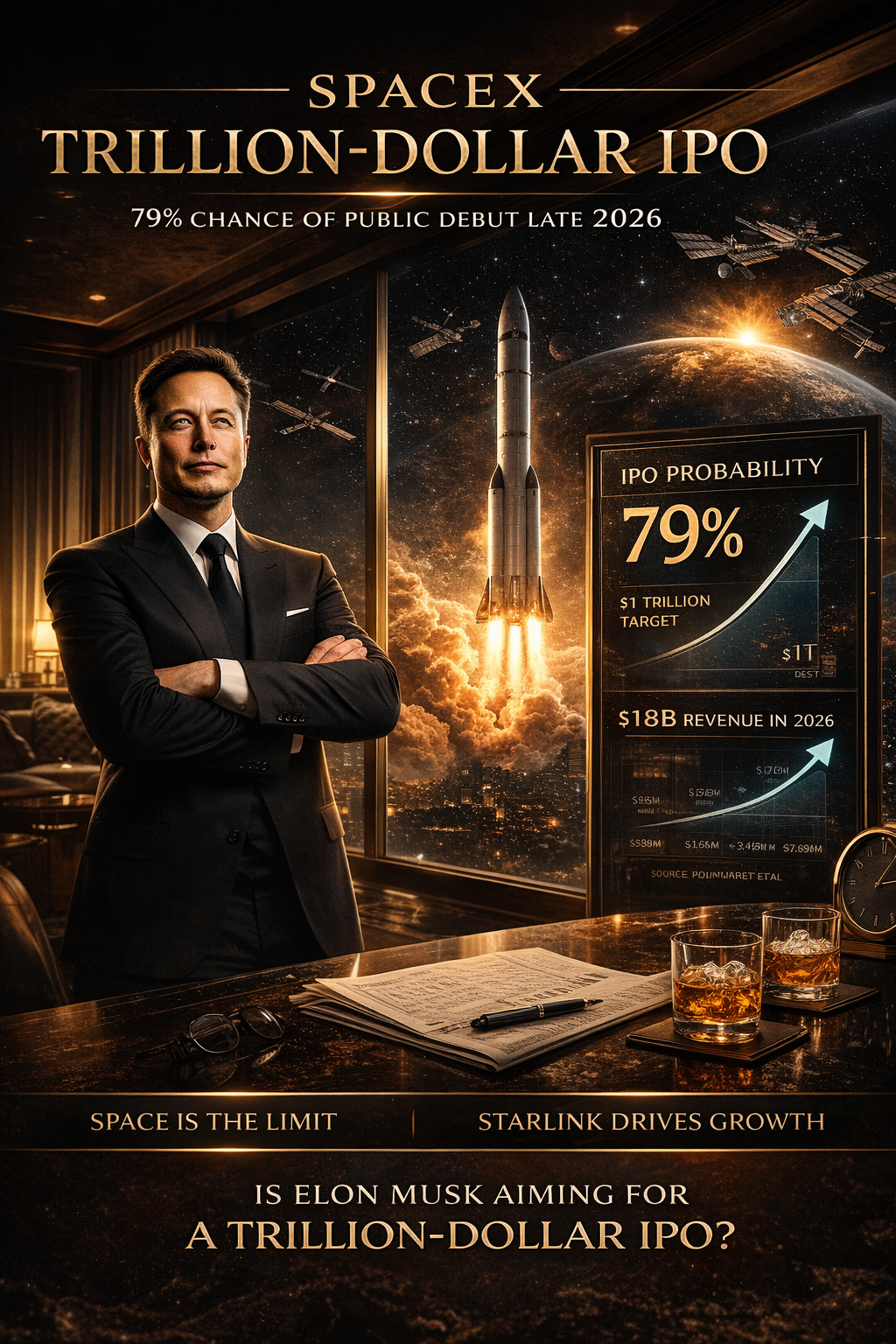
The quantified consensus regarding the valuation of the private aerospace sector reached a historic milestone this week, as prediction markets moved to price in the "Trillion-Dollar SpaceX" thesis as a high-probability event. Participants on Polymarket now assign a 79% market-implied probability to SpaceX achieving a $1 trillion valuation upon its public debut, currently targeted for late 2026. This surge in confidence follows a secondary share sale in December that valued the company at $800 billion, a figure that Elon Musk later described as "too low" given the firm's transition into a cash-flow-positive entity. The "Wisdom of Crowds" is increasingly signaling that the transition from a private "Mars-focused" venture to a public "Space Infrastructure" utility is nearing its conclusion. The momentum is driven by the maturation of Starlink, which generated an estimated $15 billion in revenue in 2025 and is projected to scale toward $24 billion by the time the IPO window opens.
The Institutional Shift and the $1.5 Trillion Target
While the $1 trillion mark represents the primary psychological threshold for prediction markets, a secondary "super-consensus" is forming around an even more aggressive $1.5 trillion figure. This shift in sentiment is rooted in the strategic pivot SpaceX has made toward becoming a fundamental global utility. Beyond its dominance in the launch market—where it was responsible for nearly 75% of all mass sent to orbit in 2025—the company is now positioning itself as a leader in orbital data centers and high-margin defense services through its Starshield vertical. On platforms like Kalshi, traders are increasingly discounting the risks associated with "Musk's Mars mission" in favor of the predictable, recurring revenue generated by the Starlink satellite constellation.
This shift follows direct confirmation from the CEO in late 2025 that an IPO is "happening soon," effectively ending nearly 25 years of resistance to public market scrutiny. The market-implied probability of 79% suggests that participants view the current regulatory environment as a tailwind. The Trump administration’s Executive Order on "Enabling Competition in the Commercial Space Industry" has aimed to streamline launch licensing and expedite environmental reviews, reducing the "bureaucratic friction" that traders previously cited as a major risk to a 2026 listing. Consequently, the crowd is betting that the largest stock market debut in history is no longer a matter of "if," but of how much capital the public markets can absorb.
Dual-Outcome Analysis: Sovereign Corporations versus Innovation Ceilings
As the 79% predictability number solidifies, the market is weighing the systemic implications of SpaceX’s entry into the public sphere.
Scenario A: The $1 Trillion+ Sovereign Corporation If SpaceX achieves or exceeds a $1 trillion valuation by December 2026, it would solidify its status as a "Sovereign-level" corporation. This outcome would likely trigger a massive rotation of capital out of traditional aerospace and defense contractors, such as Boeing and Lockheed Martin, as investors seek exposure to the "Space Infrastructure" monopoly. Systemically, this would turn Elon Musk into the world's first trillionaire and provide the parent company with the massive, low-cost capital needed to fund the development of Starship for interplanetary colonization.
Scenario B: The Under-$1 Trillion "Innovation Ceiling" Conversely, the 21% minority outcome assumes that even for a "generational play" like SpaceX, the "Innovation Premium" has a ceiling. If the IPO valuation falls short of the $1 trillion mark, it would suggest that high interest rates and increased competition from Project Kuiper or AST SpaceMobile have finally anchored the aerospace sector’s multiples. This path would likely lead to a re-rating of the entire space economy, signaling that the public market’s appetite for long-dated, capital-intensive "frontier tech" is more limited than the private secondary markets currently suggest.
Market Outlook: The Timeline and the Value Gap
At 79%, the market is effectively treating a record-breaking debut as a baseline expectation. The real "future-telling" signal within the data is the compressed 11-month timeframe; traders are betting heavily that the IPO filing will occur by mid-2026 to capitalize on current deregulation momentum. However, a potential value gap may reside in the "Starlink Spinoff" thesis. Some participants (13%) believe that Musk may pivot to taking the Starlink subsidiary public first—a "head fake" that would allow the parent company to retain its private status while still securing the capital needed for Mars. If this scenario gains traction, the 79% probability for a full SpaceX IPO may see a sharp correction as capital shifts toward the more "predictable" cash-cow entity.
This analysis of market probability does not constitute financial advice.